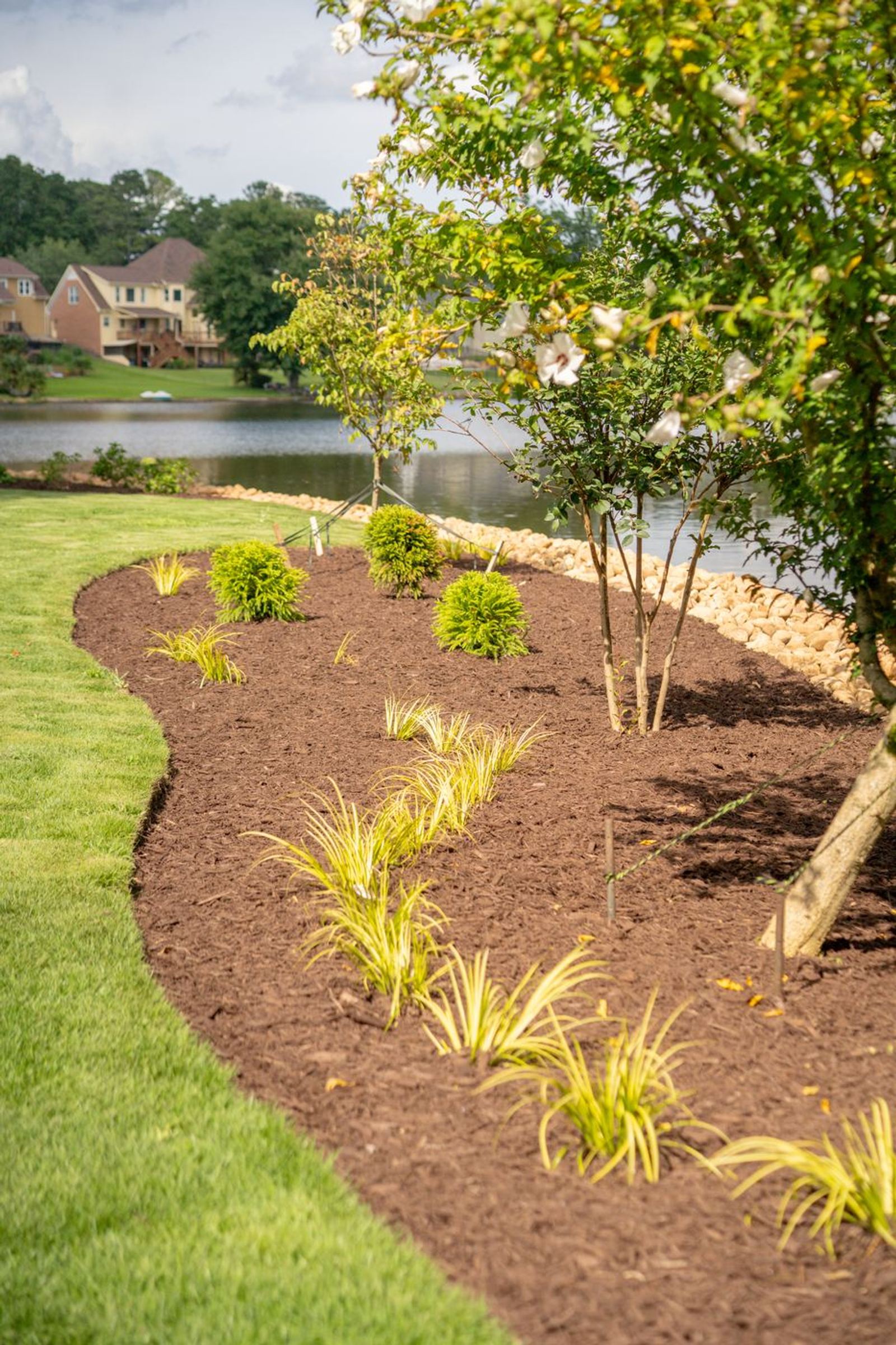
When clients come to us wanting to refresh their landscape beds, the first thing they ask about is mulch. The second thing they do is pile it on way too thick.
It makes sense why. More mulch feels like more protection, longer-lasting color, better weed control. But in Georgia's climate, that logic backfires fast.
Here's what we've learned after years of designing and maintaining landscape beds across North Georgia, and what you need to know before your next mulch delivery arrives.
The "More Is Better" Problem
Most homeowners think thick mulch layers will last longer and prevent weeds better. So they apply four, five, even six inches of mulch around their plants.
Then something strange happens over the next 6-12 months.
The mulch becomes denser as it breaks down. In Georgia's humidity, which regularly exceeds 80% during summer months, organic mulch compacts and creates a moisture trap around plant stems and trunks. This essentially drowns the plants, causing them to slowly decline.
The optimal depth for organic mulch is 2-4 inches maximum, with a critical 3-5 inch buffer zone around plant stems. When mulch is piled against trunks or applied too thickly, roots may grow into the mulch rather than into the soil, weakening the plant.
This damage appears gradually and is difficult to reverse.
Here's the other issue nobody thinks about: more mulch doesn't equal more color. As time goes on, those layers build up. Each season you add more, you're creating more work for when it's finally time to remove it all.
Pine Straw vs. Hardwood Mulch: The Real Performance Difference
People have strong opinions about pine straw versus hardwood mulch. Most of those opinions are based on aesthetics, not performance.
Here's what actually matters in Georgia:
Pine straw degrades faster. You'll need to refresh it twice annually to maintain appearance. The needle structure includes natural preservatives that slow bacterial breakdown even in humid conditions, but it still doesn't last as long as hardwood options.
Hardwood mulch, on the other hand, builds up into problematic layers over time. It becomes denser as it decomposes, particularly in Georgia's humidity, and creates that moisture trap we mentioned earlier.
So what's the smart move?
We prefer hardwood mulch for most applications. It's healthier for the soil as it decomposes, makes plants contrast nicely, and doesn't need to be removed every single season. You're looking at removal maybe once every other year instead of twice-yearly replacements.
The trade-off: mulch requires an edge restraint, whereas pine straw doesn't.
The Edge Restraint Reality
Pine straw can simply be rolled with a blower to create a nice neat edge by itself. Mulch without edge restraint washes away and gets messed up when the grass is edged.
You have two options:
- Formal edge restraint: Metal, plastic, or stone edging that physically contains the mulch.
- Natural trench edge: A dug border that works when you have thick, healthy grass, but needs to be re-dug as part of bed prep before each mulch installation.
Clients who skip this step to save money end up spending more time and money fixing the mess after every heavy rain. In Georgia's rainfall patterns, those heavy summer storms, all mulch types wash similarly without proper containment.
The pH Question Everyone Gets Wrong
You've probably heard that pine straw makes soil more acidic. That's partially true, but the reality is more nuanced.
Fresh pine needles right off the tree have a pH between 3.2-3.8. But here's what most people don't know: after a few days on the ground, they lose their acidity completely.
The brown pine needles you're using as mulch are not significantly acidic. Research shows that while pine needles themselves start acidic, they don't dramatically lower soil pH when used as mulch. Studies of soil samples taken from underneath decades-old pine trees show no major difference in acidity from nearby soil free of pine needles.
That said, there is a slight acidifying effect over time.
This works beautifully for acid-loving plants like:
- Azaleas, rhododendrons, camellias, hydrangeas, and holly
- Blueberries, cranberries, strawberries, raspberries, and potatoes
- Magnolias, dogwoods, oak trees, and evergreens like pine or spruce
- Bleeding hearts, begonias, petunias, and daffodils
For mixed beds with plants that don't want acidity? It's typically not a big deal, though some plants may not reach their full potential.
Hardwood mulch is heavier and usually better for soil as it decomposes, releasing organic matter that supplies nutrients and improves texture. But there's a catch: wood mulch decomposition temporarily ties up soil nitrogen during breakdown, requiring additional fertilizer applications to maintain plant health.
Mulch Color: What Actually Lasts
Clients are obsessed with mulch color. And honestly, it matters, but not in the way they think.
Brown mulch looks best the longest by far. It typically lasts 1-2 years without noticeable fading. This is why most of our clients choose it.
Black mulch? It has an initial fade right away, then slowly continues fading. Within 8-12 weeks in direct sun, it fades to gray. By eight months, it looks pretty shabby.
Red mulch starts to fade within 8-14 months, and the faded color tends to be more noticeable than faded black or brown. We almost never recommend red mulch unless the client specifically requests it.
Here's why fresh, factory-dyed mulch lasts longer: every side of the mulch pieces are colored. Sprayed dye only covers the top layer. If mulch moves at all, from wind, foot traffic, or garden hoses, the old mulch color shows through, creating a patchy look.
Are dyed mulches worth it? Yes. But choose wisely based on your timeline and aesthetic goals.
Design Principles for Color Selection
Beyond personal preference, there's strategy involved:
Black mulch looks great against white houses with black accents and more contemporary landscapes. The high contrast creates clean, modern lines.
Brown mulch is the most solid choice for traditional landscapes. It complements nearly every plant color and architectural style without competing for attention.
Red mulch is polarizing. It can overwhelm plantings and clash with brick or stone. Use it sparingly, if at all.
The Cost Reality: DIY vs. Professional Installation
Let's talk numbers, because this is where most people underestimate what they're actually spending.
There are two very different cost conversations here: what you pay for materials if you do it yourself, and what you pay when you hire a professional. Understanding both helps you make a smarter decision upfront.
DIY Material Costs
If you're sourcing and installing mulch yourself, here's what you can expect to pay in Georgia:
- Pine straw: $4.50 to $5.50 per bale
- Hardwood mulch: $33 to $38 per cubic yard
- Bagged mulch: $2 to $4 per bag
These are material-only costs. You're also factoring in your time, any equipment rentals, and the physical labor of moving and spreading everything yourself.
Professional Installation Costs
When you bring in a pro, pricing typically covers materials, delivery, and installation, but does not include prep work. That's a separate line item, and an important one.
- Pine straw: $9 to $11 per bale installed
- Hardwood mulch: $90 to $120 per cubic yard installed
That markup reflects more than just labor. You're paying for a crew that knows proper depth, knows how to keep mulch away from plant stems, and knows how to edge and finish a bed so it actually holds. Done right, professional installation means you're not redoing this every six months.
What's not included in those numbers is bed prep: the edging, trimming, and stem clearance we cover in the next section. If your beds need serious work before mulch goes down, plan for that as an additional cost. It's worth it.
What Matters More Than Mulch Type
Here's what most people miss entirely: the most important part of installing mulch is the bed prep beforehand.
Not the mulch type. Not the color. Not even the depth.
The prep work.
Here's what proper bed prep looks like:
- Edge work: Ensure all edges are dug out, even against formal edges, so new mulch won't spill over onto grass or hardscaping.
- Stem clearance: Remove any mulch mounded around plant stems. This prevents that moisture trap and root rot we talked about earlier.
- Plant maintenance: Prune and trim all plant material before mulch goes down. This creates clean lines and ensures you're not covering up problems.
Skip these steps, and even the best mulch will fail. Diseases like root rot, crown rot, and various turf fungi often result from mulch that's too thick, poorly distributed, or left undisturbed for extended periods.
Without correcting the mulch issue, treatments alone rarely solve the problem long term.
Your Mulch Decision Framework
Before you order your next load of mulch, ask yourself three questions:
- What do I actually like? You'll see this material every day. Choose something that makes you happy, not just what's trendy.
- What complements the landscape best? Consider your home's exterior, existing hardscaping, and plant material. The mulch should enhance, not compete.
- What will look best the longest? Factor in your maintenance capacity, budget, and realistic expectations about refresh cycles.
Then make sure your bed prep is solid. Because that's what actually determines whether your investment pays off or becomes a recurring problem.
The Bottom Line
Mulch selection isn't about finding the "perfect" material. It's about matching the right material to your specific situation: your climate, your plants, your maintenance capacity, and your design goals.
In Georgia, that means understanding how humidity affects decomposition, how rainfall patterns impact erosion, and how your soil chemistry changes over time.
It means accepting trade-offs: pine straw's natural look versus hardwood's longevity, black mulch's dramatic contrast versus brown mulch's staying power, upfront edge restraint costs versus ongoing maintenance headaches.
And it means recognizing that proper installation matters more than premium materials. A $50 load of basic brown mulch installed correctly will outperform a $200 load of premium dyed mulch dumped without proper prep.
That's the Georgia mulch method: strategy before aesthetics, preparation before installation, long-term thinking before short-term fixes.
Your landscape beds deserve that level of care.
